The Qabalah’s Tree of Life is a glyph that represents, simultaneously, two directions: the flow of the Divine from Above to Below, and the Path of Return to Source, from Below to Above, for those on spiritual journeys of enlightenment. It is a glyph that represents all of creation and all the energies of creation.
The Tree of Life is comprised of ten circles called Sephiroth and the 22 paths that connect them. The Paths are subjective, and allocated to the 22 letters of the Hebrew alphabet as well as the 22 Major Arcana of the Tarot. The 10 Spheres are objective and are considered emmanations of the Divine. They are allocated to the First Swirlings, the Zodiac, the six visible planets, the Moon and the Earth.
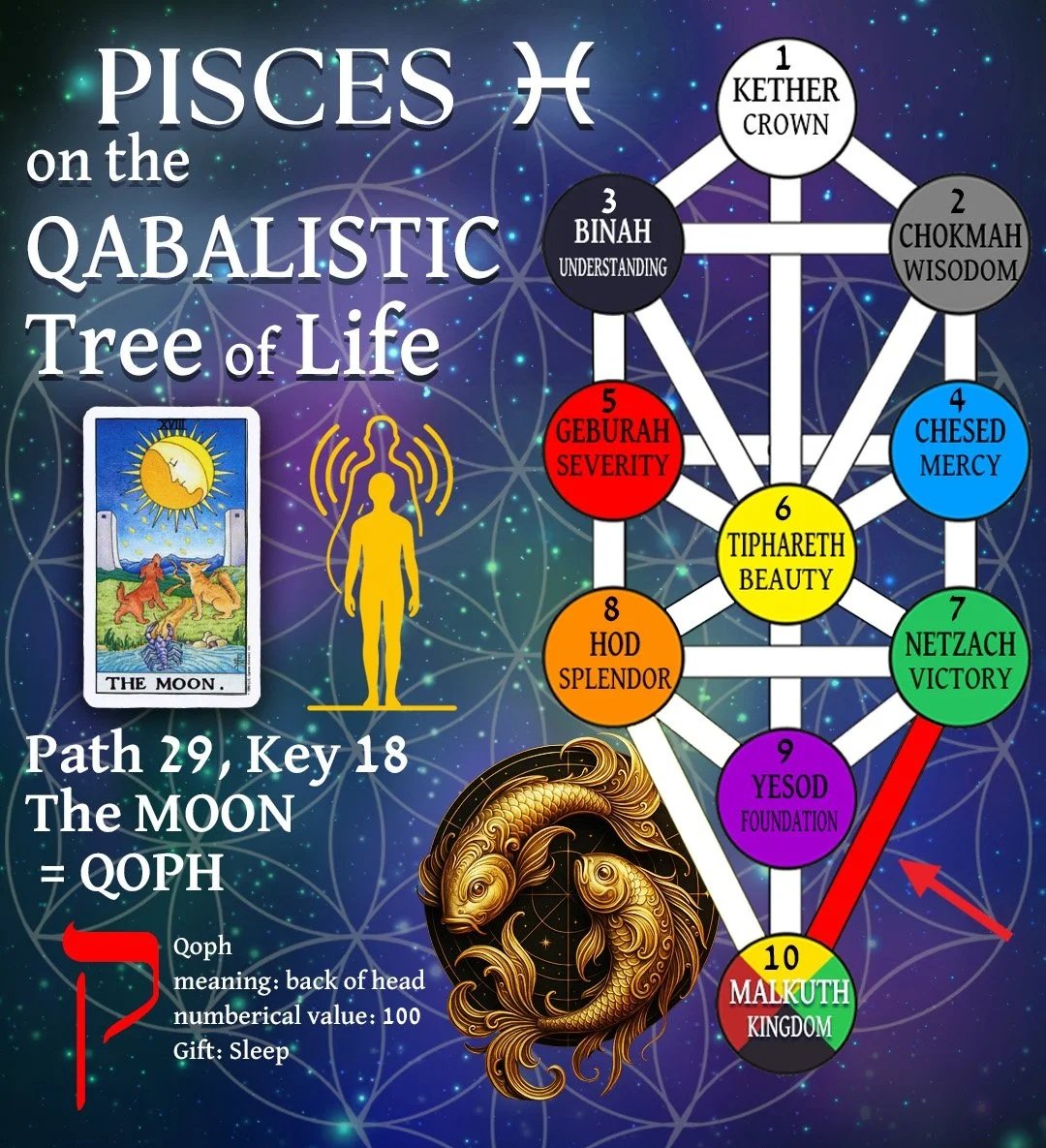
Pisces is represented on the Tree of Life through its associated Tarot Card, which is Key 18, The Moon. The 18th Path connects Netzach (Victory) to Malkuth (The Kingdom) on the Tree of Life. It is described as the “victory of the material world” as well as the “deceptive effect of the apparent power of the material world.” The Hebrew letter for this path is Qoph (ק), which means Back of the Head. Its numerical value is 100, it is a simple letter - its “gift” – is sleep. It is one of three paths or letters that form the word Qesheth, (Qoph, Shin, Tav) which means Rainbow or just simply Bow. These three paths connecting Malkuth (Foundation) to the Tree above it and basically form what can be seen as a Bow and Arrow. The central path of Tav corresponds to the Arrow, and corresponds conveniently to Temperance/Sagittarius (see Sagittarius and the Qabalistic Tree of Life.) The other two paths, Qoph and Resh, form the Bow proper, created by the polarity of fire and water, with Shin as the fiery spirit and Qoph as the watery reflective.
The letter Qoph’s “gift” of Sleep holds two meanings. First, in the context of incarnation, it refers to the state of the Soul before awakening into incarnate mortal consciousness. Secondly in the context of spiritual development, it is the conquest of the waterly subconsious of a person’t own mind, where phantoms of the person’s own making, in additions of those of the entire human race, must be dealt with. It is considered to be a path that can be somewhat frightening, however when we slay the dragons of our sleep-consciousness, we gain the capacity to manipulate them. In both instances, sleep is seen as a necessary transitory state that concludes by waking up, or gaining a new type or evolved consciousness.
In modern language, “waking up” can mean very different things depending on context. In conspiracy-oriented consciousness, it often refers to becoming aware of hidden systems of control, secrecy, or manipulation. Becoming Awake is framed as a veil being lifted from a person’s eyes, exposing the lies and concealed truths beneath official narratives. Spiritual awakening, by contrast, traditionally describes a shift in identity from ego-centered perception to expanded awareness, unity, or direct experiential insight into deeper reality. Meanwhile, the term “woke” has evolved in modern times to signify social and political awareness, particularly regarding injustice and systemic inequality, though it has also become polarized and politicized. All three share the metaphor of moving from sleep to awareness, yet they diverge in direction; one looking outward for hidden structures, one inward toward consciousness itself, and one toward collective ethical and social dynamics. The back of the head contains the cerebellum, responsible for orientation, balance and coodination. Those qualities, although they refer to physical movement, can also be applied to consciousness, and to which brand of Awake a person navigates to.
Each form of “waking” reflects the Hermetic principle of Mentalism, the understanding that reality is shaped and interpreted through consciousness itself, and is, in essence, a shared simulation. Whether one question systems and official narratives, dissolves the ego, or is drawn toward justice and reform, the quality of awakening depends on the perceptive compass of the mind. Here the Hebrew letter Qoph (ק) can be considered. Associated with the Moon and the subconscious, Qoph governs the realm of reflection, dreams and illusion where images can either distort or reveal truth. It reminds us that awakening is not merely exposure to new information, but discernment within the lunar field of perception. In Hermetic terms, true awakening occurs when reflected light is recognized as reflection, and the seeker learns to distinguish projection from illumination.
Sources:
Tarot Correspondences by T. Susan Chang
Kabbalah by Charles Ponce
Qabalistic Tarot by Rober Wang
Llewellyn’s Complete Book of Correspondences by Sandra Kynes
Hermetic Qabalah by Oliver St. John
The Secret Teachings of All Ages by Manly P. Hall