The Qabalah’s Tree of Life is a glyph that represents, simultaneously, two directions: the flow of the Divine from Above to Below, and the Path of Return to Source, from Below to Above, for those on spiritual journeys of enlightenment. It is a glyph that represents all of creation and all the energies of creation.
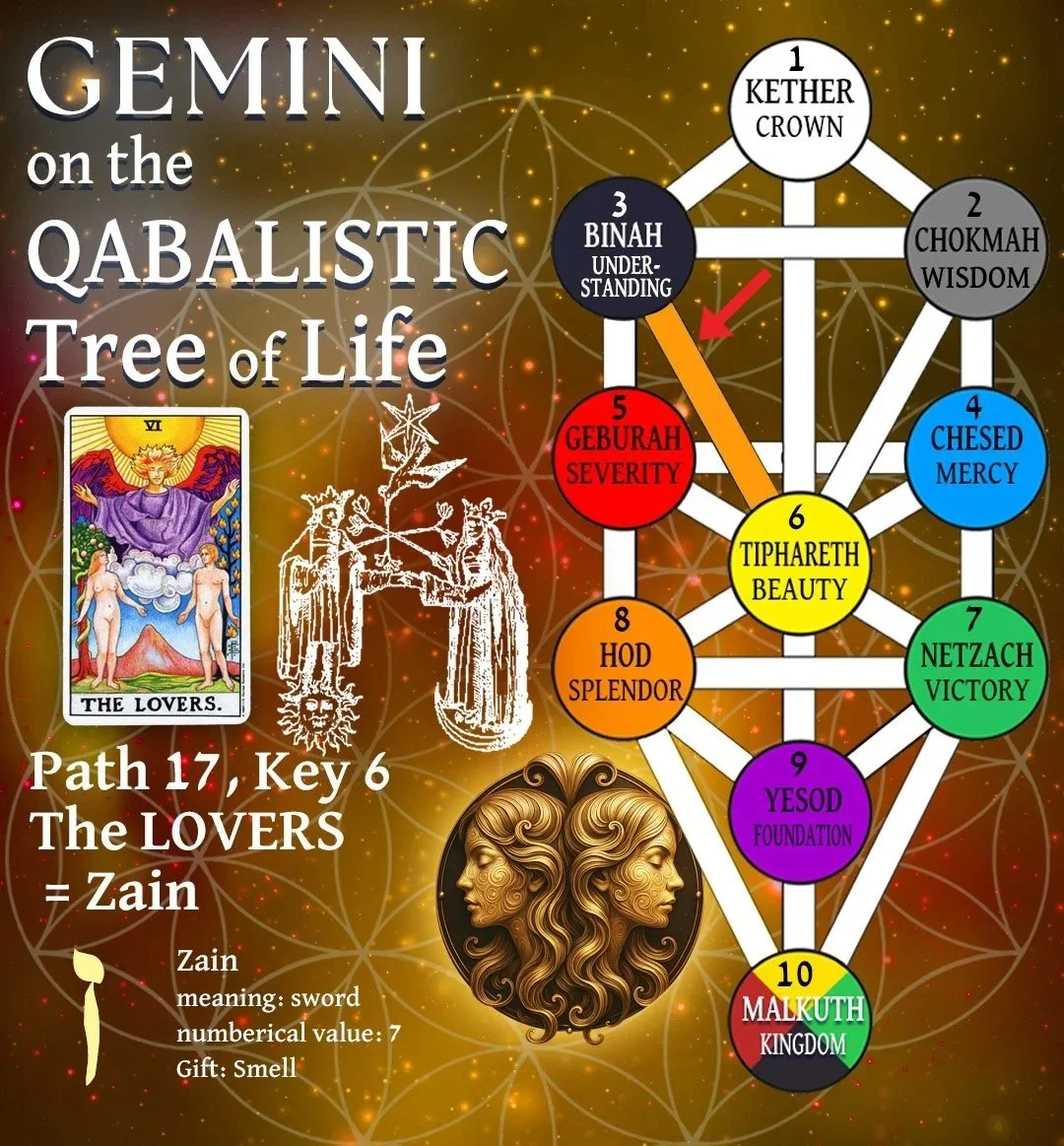
The Tree of Life is comprised of ten circles called Sephiroth and the 22 paths that connect them. The Paths are subjective, and allocated to the 22 letters of the Hebrew alphabet as well as the 22 Major Arcana of the Tarot. The 10 Spheres are objective and are considered emmanations of the Divine. They are allocated to The First Swirlings, the Zodiac, the six visible planets, the Moon and the Earth.
Gemini is represented on the Tree of Life through its associated Tarot Card, which is Key 6, The Lovers, also known as the 17th Path on the Qabalistic Tree of Life. The 17th Path connects the Sephirah Tiphareth (Beauty) to Binah (Understanding). It is one of the three paths that crosses the Abyss, which separates the Supernal Triad (the 3 top circles, or Sephirah) from the rest of the Tree. The Hebrew letter for this path is Zain, which means Sword. Its numerical value is 7, and it is one of the twelve simple letters. It’s “gift” is smell.
The Paths on the Tree of Life each have an “Intelligence” taken from writings of the Sefer Yetzirah, one of the oldest and most mysterious Kabbalistic texts: “The Seventeenth Path is called the Disposing Intelligence, which provides Faith to the Righteous, and they are clothed with Holy Spirit by it, and it is called the Foundation of Excellence in the state of higher things.” Although cryptic, this description can be seen to be connected to the alchemical interpretation of the card, which is not about love between individuals, but about the Chemical Marriage of the Self with the Subconscious and the Divine; the marriage between Sulfer, Salt and Mercury.
The Great Work, an alchemical title for the work of an Initiate, or anyone on a spiritual journey towards enlightenment, is sometimes referred to as “the union of the Sun and Moon under the influence of Mercury.” This means the union of opposites, fire and water, sulphur and salt, male and female, soul and the body, or Consciousness and Subconsciousness, under the influence of Mercury, which is Spirit, Super-consciousness, or connection with the Divine. The 17th Path is ultimately about this marriage or union of these three concepts.
The “Disposing Intelligence” in this case probably does not refer to something that is disposed of, but rather refers to the putting of things in their proper places or in proper relationship to one another - basically arranging them. In this case, most likely, the “things” are aspects of the self. When the aspects of the Self are properly aligned, a sort of natural Trust-in-Self arises, decribed perhaps as “faith to the righteous.” When this happens, inspiration and divine guidance can come through, described perhaps as “clothed in Spirit,” which lays the groundwork for higher spiritual advancement or “Foundation of Excellence in the state of higher things.” Aligning aspects of the Self becomes an act of Self Love under the influence of Divine Love.
Lastly, this path is attributed to the Hebrew letter Zain, which means sword. Although there is some debate between Crowley, Case and others about the role of Zain on this path, or in the Lovers Card, it is generally recongized that because the 17th Path connects Binah, a sephirah in the Supernal Triad, to Tiphareth, it crosses the Abyss between the two. And the Abyss is where the path of what is knowable while alive ends; that is, the Supernal Triad is unknowable by living Souls, who may learn of the true mysteries beyond as discarnate beings. That this path crosses such a divide relates to the symbolism of the Sword, which is a tool of separation.
Sources:
Tarot Correspondences by T. Susan Chang
Kabbalah by Charles Ponce
Qabalistic Tarot by Rober Wang
Llewellyn’s Complete Book of Correspondences by Sandra Kynes
Hermetic Qabalah by Oliver St. John
The Secret Teachings of All Ages by Manly P. Hall